
Optical Components Beam division optics
Diamond Beam Splitters
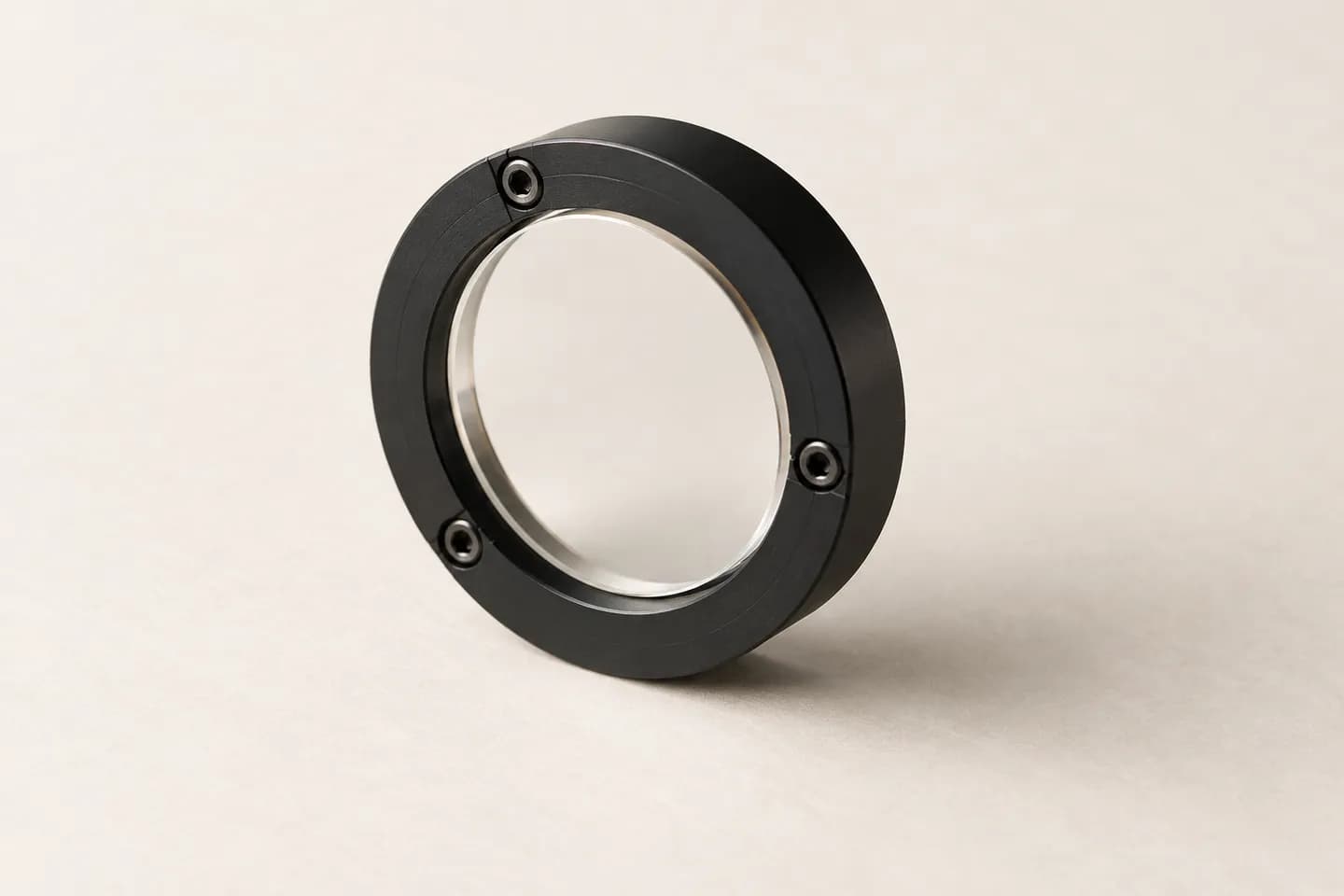
Divides a beam into transmitted and reflected paths.
Good to know
- The split depends on wavelength, incidence angle and surface treatment.
- A controlled wedge can reduce unwanted interference fringes.
- Flatness and surface quality influence the transmitted wavefront.
Specifications
What we define for diamond beam splitters, with units and how each is typically measured. We confirm values for your application in technical review.
Request the datasheetLook up a term in the glossaryDimensions & tolerances
| Parameter | Unit | Typical test method |
|---|---|---|
| Parallelism or wedge | arcmin | Autocollimator or interferometry |
| Clear aperture | mm | Optical measurement to drawing |
| Thickness and tolerance (bulk or layer) | mm | Micrometer or optical gauge |
| Flatness or surface figure, and bow | µm or fringes | Interferometry (633 nm) or profilometry |
| Lateral size, outline or diameter, and tolerance | mm | Optical measurement |
Surface & finish
| Parameter | Unit | Typical test method |
|---|---|---|
| Surface quality (scratch and dig) | Visual inspection (ISO 10110-7) | |
| Surface roughness per side | nm Ra | Profilometry or AFM |
Optical performance
| Parameter | Unit | Typical test method |
|---|---|---|
| Split ratio and angle of incidence | % | Spectrophotometry |
| Transmittance over operating band or photon-energy range | % | FTIR or UV–Vis spectrophotometry |
| Coating construction and thickness | nm | Spectrophotometry, XRF or cross-section |
| Optical scatter and haze | % | Integrating-sphere measurement |
| Birefringence | nm/cm | Polarimetry |
| Transmitted wavefront error | fringes | Interferometry |
| Laser-induced damage threshold | J/cm² | Laser damage test (ISO 21254) |
| Coating adhesion and environmental durability | Tape and humidity test (ISO 9211) | |
| Refractive index and dispersion | Ellipsometry or prism coupling |
Where it is used
- Lasers & PhotonicsOptics must transmit light and survive heat load; diamond transmits and conducts heat away.
- Semiconductor EquipmentProcessing demands precision, cleanliness and compatible materials; diamond parts are specified around all three.
- Research & QuantumExperiments need pure material and sensitive measurement; diamond is specified to your conditions.
Requirement to review
Have a material requirement? Let’s review it.
Share your diamond beam splitters requirement, dimensions and drawing for review.