
Diamond Composites Ceramic-matrix material
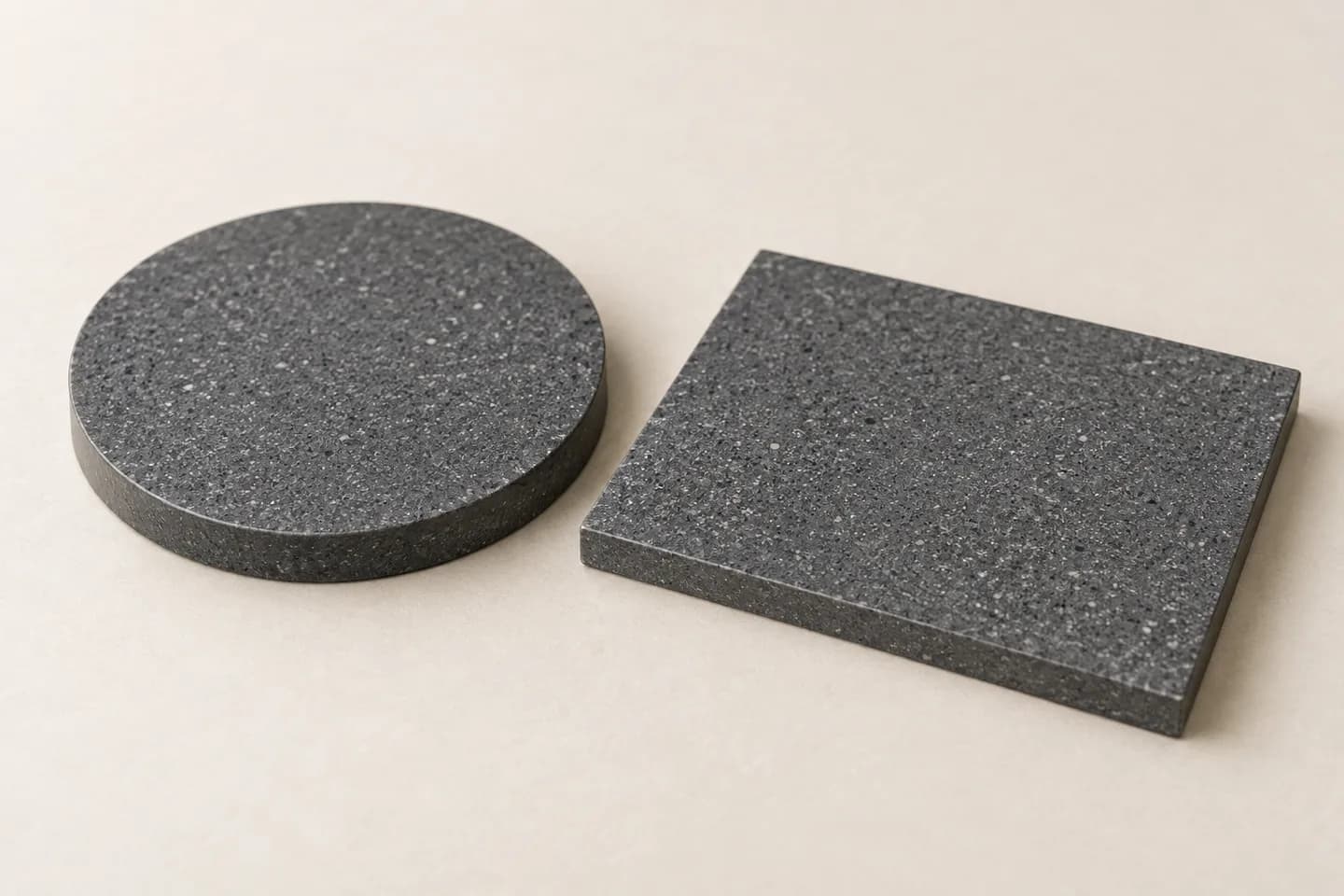
Diamond–Silicon Carbide Composite
Diamond combined with silicon carbide as a ceramic composite.
Good to know
- Thermal and mechanical behaviour depend on composition and processing.
- Electrical insulation must be qualified for the selected formulation.
- A ceramic composite has different joining requirements from a metal-matrix plate.
Specifications
What we define for diamond–silicon carbide composite, with units and how each is typically measured. We confirm values for your application in technical review.
Request the datasheetLook up a term in the glossaryDimensions & tolerances
| Parameter | Unit | Typical test method |
|---|---|---|
| Flatness or surface figure, and bow | µm or fringes | Interferometry (633 nm) or profilometry |
| Lateral size, outline or diameter, and tolerance | mm | Optical measurement |
| Thickness and tolerance (bulk or layer) | mm | Micrometer or optical gauge |
| Edge condition and chip limit | Microscopy inspection to drawing |
Surface & finish
| Parameter | Unit | Typical test method |
|---|---|---|
| Surface finish condition (as-grown, lapped or polished) | Visual inspection to drawing | |
| Surface roughness per side | nm Ra | Profilometry or AFM |
Material properties
| Parameter | Unit | Typical test method |
|---|---|---|
| Thermal conductivity grade | W/m·K | Laser flash (ASTM E1461) |
| Coefficient of thermal expansion (per temperature range) | ppm/K | Thermomechanical analysis (ASTM E831) |
| Density | g/cm³ | Archimedes method |
| Porosity and void content | % | Density comparison or acoustic microscopy |
| Young's modulus | GPa | Resonance method (ASTM E1876) |
| Thermal conductivity versus temperature | W/m·K | Laser flash over temperature (ASTM E1461) |
Metallization & joining
| Parameter | Unit | Typical test method |
|---|---|---|
| Solder or braze compatibility | Wetting and shear test |
Electrical & electrochemical
| Parameter | Unit | Typical test method |
|---|---|---|
| Electrical resistivity and test conditions | Ω·cm | Four-point probe |
Integration & packaging
| Parameter | Unit | Typical test method |
|---|---|---|
| Certificate of conformance and traceability | Supplier declaration |
Where it is used
- Telecom, RF & RadarRF power raises junction temperature; diamond helps carry heat away while interfaces stay reliable.
- Power Electronics & EVsTemperature cycling demands expansion balance and isolation; diamond components help manage the heat.
- Aerospace & DefenceMass and harsh environments constrain thermal design; diamond offers a route for moving heat.
Requirement to review
Have a material requirement? Let’s review it.
Share your diamond–silicon carbide composite requirement, dimensions and drawing for review.