
Thermal Components Grade or surface option
Metallized Diamond
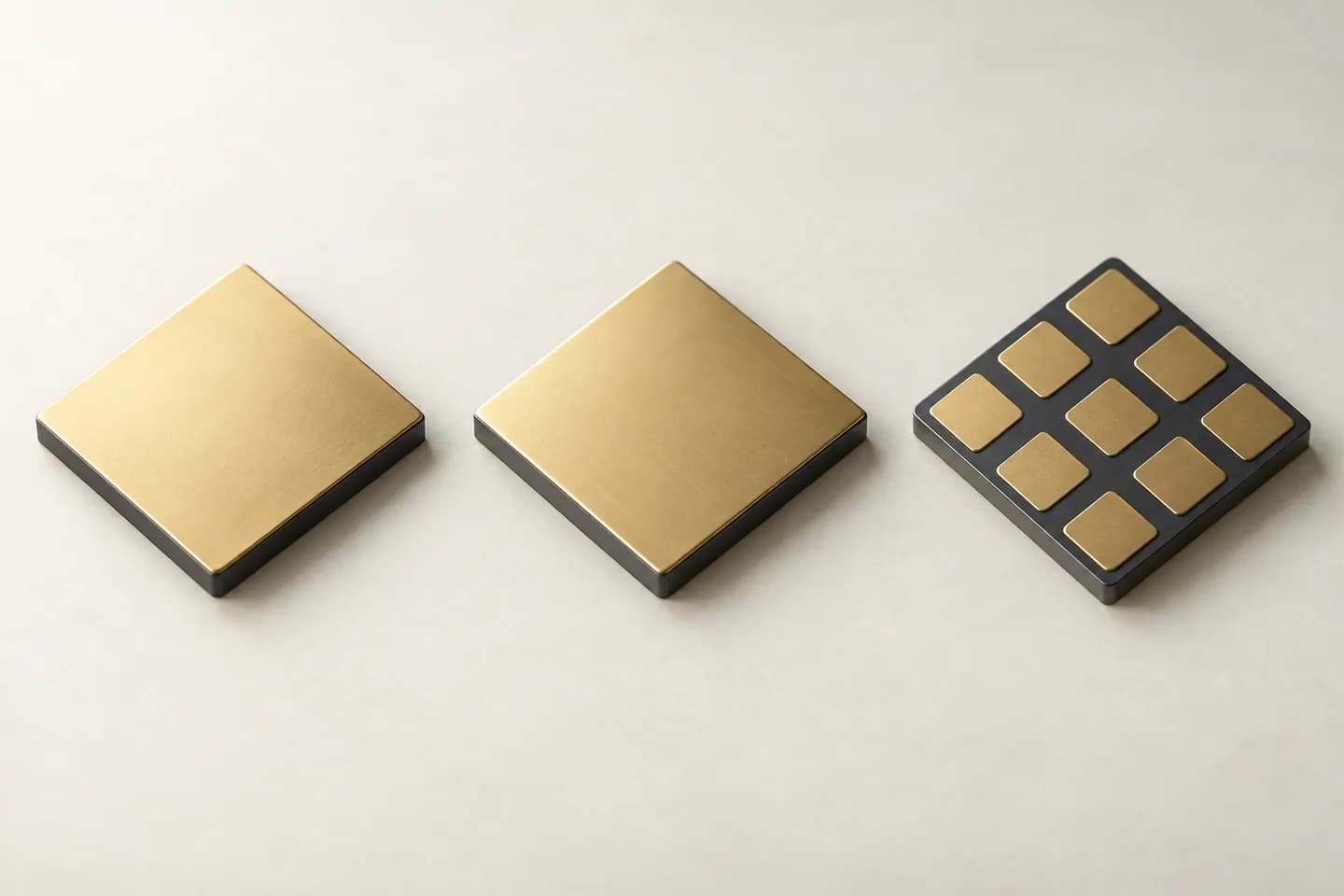
Diamond with metal layers, ready for joining or making electrical contact.
Good to know
- Layer sequence, thickness and coverage define the metallization.
- Patterned metal must preserve any required isolation between contact areas.
Specifications
What we define for metallized diamond, with units and how each is typically measured. We confirm values for your application in technical review.
Request the datasheetLook up a term in the glossaryDimensions & tolerances
| Parameter | Unit | Typical test method |
|---|---|---|
| Thickness and tolerance (bulk or layer) | mm | Micrometer or optical gauge |
| Lateral size, outline or diameter, and tolerance | mm | Optical measurement |
| Flatness or surface figure, and bow | µm or fringes | Interferometry (633 nm) or profilometry |
| Edge condition and chip limit | Microscopy inspection to drawing |
Surface & finish
| Parameter | Unit | Typical test method |
|---|---|---|
| Surface roughness per side | nm Ra | Profilometry or AFM |
Material properties
| Parameter | Unit | Typical test method |
|---|---|---|
| Thermal conductivity grade | W/m·K | Laser flash (ASTM E1461) |
Metallization & joining
| Parameter | Unit | Typical test method |
|---|---|---|
| Metallization or plating stack and thickness | nm per layer | XRF or cross-section |
| Metal adhesion | N | Pull or scratch test |
| Metallization pattern and coverage | Optical inspection to drawing | |
| Solder or braze compatibility | Wetting and shear test | |
| Process temperature budget and thermal cycling | °C | Thermal-cycle test with post-test inspection |
| Wire-bond and die-attach compatibility | Bond-pull and die-shear test | |
| Heat-cycle dimensional stability | cycles | Thermal-cycle test with post-test inspection |
Integration & packaging
| Parameter | Unit | Typical test method |
|---|---|---|
| Operating temperature limit | °C | Per application brief |
| Certificate of conformance and traceability | Supplier declaration |
Where it is used
- Computing & Data CentresDense heat and tight package space need a short path to cooling; diamond spreads it.
- Telecom, RF & RadarRF power raises junction temperature; diamond helps carry heat away while interfaces stay reliable.
- Power Electronics & EVsTemperature cycling demands expansion balance and isolation; diamond components help manage the heat.
- Lasers & PhotonicsOptics must transmit light and survive heat load; diamond transmits and conducts heat away.
Requirement to review
Have a material requirement? Let’s review it.
Share your metallized diamond requirement, dimensions and drawing for review.